


Table of Contents
Table of Contents
- Overview: Why Contracts, Handbooks, and Approvals Anchor a Compliant China Team
- Labor Contract Types Under PRC Law
- Essential Clauses Every Compliant Labor Contract Must Include
- The One-Month Signing Deadline and Double-Wage Risk
- Employee Handbooks: The Democratic Procedure Requirement
- Government Approvals and Filings You Cannot Skip
- How Knit's EOR China Service Executes All Three Pillars
- Common Mistakes When Copy-Pasting a Home-Country Template
- Frequently Asked Questions
- Glossary of Key Terms
- Related Reading
1. Overview: Why Contracts, Handbooks, and Approvals Anchor a Compliant China Team
Foreign companies building a team in mainland China tend to treat HR paperwork as an administrative afterthought — something to finalize once the offer is accepted and the desk is assigned. In China, that ordering is backwards. The PRC Labor Contract Law and its implementing regulations make the labor contract, the employee handbook, and a handful of government filings the legal foundation on which every subsequent HR decision rests, including performance management, discipline, and termination.
This matters because China has no concept of "at-will" employment. An employer cannot end an employment relationship simply because the fit isn't working; termination without the employee's consent is permitted only on specific statutory grounds, and each ground carries its own documentation burden. That documentation burden is met — or isn't — long before the termination conversation ever happens. A dismissal for poor performance is only defensible if the employer can show what "poor performance" meant, and that showing depends on a handbook or performance policy the employee was properly bound to. A dismissal for serious violation of workplace rules is only defensible if those rules were lawfully adopted in the first place. In practice, arbitrators and courts trace disputes back to whether the underlying contract and handbook were compliant at formation — not just whether the final decision felt fair.
For foreign-invested entities and companies using an Employer of Record (EOR) structure to hire in China without setting up a Wholly Foreign-Owned Enterprise (WFOE), getting these three pillars right from day one is not a nicety — it is the difference between a defensible personnel decision two years from now and an arbitration award that includes reinstatement or double compensation. The remainder of this article walks through each pillar in the depth a foreign HR or legal team actually needs to make informed decisions, and where Knit's EOR China service takes the execution burden off the client's plate.
2. Labor Contract Types Under PRC Law
Chinese labor law recognizes three distinct labor contract types, and the choice is not merely a drafting preference — each type carries different legal consequences for renewal, termination, and long-term headcount planning.
Fixed-term contracts specify a defined start and end date and are by far the most common contract type used for new hires in China. They are appropriate for most standard roles, especially in the first one to two employment cycles with a given employee, because they give the employer a natural, low-friction point to reassess fit at the term's expiry without needing a statutory termination ground.
Open-term contracts, sometimes called non-fixed-term or "permanent" contracts, have no set end date and continue until a statutory termination event occurs. Critically, an open-term contract is not simply an option an employer can offer at its discretion — Chinese law makes it mandatory to offer once either of two triggers is met: (1) the employee has completed two consecutive fixed-term contracts with the employer and is up for a third renewal, or (2) the employee has accumulated ten years of continuous service with the employer. If the statutory trigger is met and the employer does not offer an open-term contract, or fails to sign a new contract entirely, the legal consequences mirror the non-signing penalties described in Section 4 — including the contract being deemed open-term by operation of law. Employers frequently miscalculate the "two consecutive renewals" trigger by resetting the clock on a short break in service; local labor bureaus generally do not permit this workaround if the break is a formality rather than a genuine cessation of the employment relationship.
Task-based or project-based contracts end automatically upon completion of a specified task or project rather than on a calendar date. These are appropriate for genuinely time-bound, deliverable-defined work — a specific construction phase, a defined consulting engagement, a product launch team stood up for a fixed scope — but are a poor fit for ongoing roles with no natural completion point. Using a task-based contract for what is functionally an open-ended role is a common compliance shortcut that rarely survives scrutiny in arbitration, because the "task" cited often has no objectively verifiable completion criterion.
Knit practical tip #1: Before offering a third fixed-term renewal, run the employee's full service history — including any prior stint at an affiliated entity or a break shorter than the local bureau's recognized "genuine gap" threshold — because the open-term trigger is based on cumulative, not just current-contract, tenure. Employers who evaluate renewal decisions contract-by-contract, without this lookback, are the ones most often surprised by an open-term obligation they didn't plan for.
3. Essential Clauses Every Compliant Labor Contract Must Include
A labor contract that is merely signed is not automatically a compliant one. PRC law specifies categories of content a written labor contract must address, and gaps in these categories — not just outright contract absence — expose the employer to disputes and, in some cases, the same penalties that apply to unsigned contracts.
At minimum, a compliant contract needs to specify:
- Job title and job description — specific enough to support a later performance or role-change argument, not a generic label like "staff member."
- Contract term — the type (fixed, open, or task-based) and, where applicable, the exact start and end dates.
- Probation terms — length and pay, both of which are capped by law based on the contract term (see the tip below), not left to employer discretion.
- Working-hours system — whether the employee is on the standard system, a comprehensive calculation system, or a non-fixed (flexible) hours system, each of which has different overtime and approval implications.
- Compensation structure — base salary, allowances, bonus structure, and how and when wages are paid; vague or incomplete compensation clauses are a leading cause of wage disputes.
- Workplace location — the actual place of work, which matters for social insurance registration jurisdiction and for assessing whether a later relocation requires employee consent.
- Social insurance commitments — an explicit acknowledgment that the employer will make statutory social insurance and housing fund contributions; silence here does not exempt the employer from the underlying legal obligation, but its absence is itself treated as a contract deficiency.
Probation length itself is capped by the underlying contract term: one month for contracts under one year, two months for contracts between one and three years, and up to six months for contracts of three years or more and for open-term contracts. Probation pay must be no less than 80% of the contracted salary, the local minimum wage, or the pay rate the employee would receive once confirmed — whichever of the three is highest.
Knit practical tip #2: Do not let probation-period pay default to "80% of base salary" as a blanket internal policy. Because the floor is the highest of three separate benchmarks, a role with a low base salary but a high confirmed-employee pay rate (common in sales roles with heavy variable pay) may require probation pay well above 80% of the stated base — a gap payroll teams frequently miss until a labor bureau inspection catches it.
4. The One-Month Signing Deadline and Double-Wage Risk
The single most consequential deadline in PRC employment law for a foreign employer is the one-month rule: a written labor contract must be signed within one month of the employee's actual start date. This clock starts on the first day the employee begins work, not on the offer date, the onboarding date, or any internally defined "official" start — a distinction that trips up companies whose internal HR systems record start dates differently than the employee's actual first day on site.
If the one-month deadline passes without a signed contract, the employer owes the employee double wages for every month the contract remains unsigned, starting from the second month of employment and continuing until a contract is executed. This is not a discretionary penalty subject to negotiation or mitigation — it accrues automatically once the deadline is missed, and it is one of the most frequently litigated wage claims in Chinese labor arbitration because it requires no proof of fault beyond the missing signature.
The exposure escalates further if the contract remains unsigned for a full year: at the one-year mark, the law deems the employment relationship to have become an open-term contract by operation of law — regardless of what the employer intended to offer, and regardless of any fixed-term contract the employer belatedly attempts to sign afterward. In effect, an employer that lets contract signing lapse for twelve months loses both the double-wage exposure already accrued and its ability to define the contract's term going forward.
Knit practical tip #3: The most common source of missed signing deadlines isn't negligence — it's a start date that shifts after the contract has already been drafted (a new hire starts early to shadow a departing employee, for example) without the contract's effective date being updated to match. Build a standing practice of confirming the actual first working day, not the planned one, as the trigger date for the one-month clock, and flag it in payroll systems the same week the employee begins.
5. Employee Handbooks: The Democratic Procedure Requirement
An employee handbook, is where most of the day-to-day substance of employment — compensation structure, disciplinary rules, working-hours arrangements, leave policies, and termination grounds — actually lives. Many foreign employers assume that once a handbook is written, translated, and distributed, it is enforceable. Under Chinese law, that assumption is wrong, and it is one of the most consequential gaps we see in newly established China operations.
For any handbook provision that directly affects employee interests, Chinese law requires the provision to be adopted through a democratic procedure before it can be enforced. This means the employer must discuss the proposed rules with, and solicit opinions from, either the employee representative congress (职工代表大会) or the broader body of employees, and — depending on the outcome of that consultation and applicable local practice — negotiate with the labor union or employee representatives on an equal footing before finalizing the content. A handbook that is drafted internally by HR or legal, translated from a headquarters policy, and rolled out to staff via email announcement — with no consultation step — has not satisfied this requirement, no matter how well-written its substantive content is.
Adoption through democratic procedure is necessary but not sufficient. The handbook must also be properly publicized and communicated to employees, in a way the employer can later prove. Acceptable methods generally include a signed acknowledgment from each employee confirming receipt and understanding, or posting on a company intranet with a verifiable record that employees accessed and were notified of the content. A handbook that sits in a shared drive with no signature record and no access log is, from an evidentiary standpoint, indistinguishable from a handbook that was never communicated at all.
The practical consequence shows up most sharply in termination disputes. When an employer terminates an employee for cause — citing a "serious violation of company rules" as the statutory ground — Chinese labor arbitration bodies routinely ask two threshold questions before even examining the alleged violation: was the rule the employee allegedly violated adopted through democratic procedure, and was it properly communicated to this employee specifically? If either answer is no, the termination is frequently ruled procedurally invalid regardless of whether the underlying conduct actually occurred, exposing the employer to reinstatement or compensation liability.
Knit Client Snapshot
A foreign-invested manufacturing company operating in eastern China terminated a mid-level employee for cause, citing repeated violations of a handbook clause governing workplace conduct. The clause had been drafted at the company's overseas headquarters, translated into Chinese by an internal bilingual staff member, and circulated to employees via a company-wide email with no formal consultation process and no individual acknowledgment requirement. When the employee challenged the termination in labor arbitration, the arbitration panel focused almost entirely on the handbook's adoption process rather than the alleged misconduct itself. Because the company could not demonstrate that the relevant provision had gone through democratic procedure or that this specific employee had acknowledged receiving it, the termination was found procedurally defective, and the company was ordered to pay compensation equivalent to the statutory measure for unlawful termination. Knit was engaged afterward to rebuild the company's handbook from the ground up: convening a proper employee consultation session, documenting the discussion and feedback incorporated, and rolling out the revised handbook with individual signed acknowledgments on file for every employee. The company retained its own substantive judgment on what the disciplinary standards should be — Knit's role was ensuring the adoption and communication process would hold up if tested again.
6. Government Approvals and Filings You Cannot Skip
Beyond the contract and the handbook, a compliant China team requires a set of government-facing approvals and filings, several of which carry statutory deadlines or require prior sign-off before an employer can lawfully implement a given policy.
Working-hours system approval. Most roles in China default to the standard working-hours system: an eight-hour day, 40-hour week, with statutory overtime rules applying to any work beyond that. Employers wanting to use a comprehensive calculation working-hours system (averaging hours over a longer cycle — common for shift-based operations) or a non-fixed (flexible) working-hours system (typically used for senior management or field-based roles with genuinely variable schedules) must obtain prior approval from the local labor bureau before implementing that system. This is not a filing an employer can complete retroactively after already scheduling staff under a non-standard system; using an unapproved comprehensive or flexible-hours arrangement exposes the employer to unpaid-overtime liability calculated under the standard system, even if the employee's actual schedule was designed around the alternative one.
Labor contract and social insurance registration. Signed labor contracts generally need to be registered or filed with the local labor bureau, and — separately — the employer must register the employee for social insurance and housing fund contributions with the relevant local bureaus within a statutory window, commonly 30 days of the employee's start date. These are location-specific administrative processes: the exact registration channel, required documents, and processing timelines vary by city and even by district, which is one reason multi-city China teams are harder to administer consistently than a single-location operation.
Work and residence permits for foreign nationals. Where a foreign company's China team-building plans include placing foreign nationals to work inside mainland China — rather than only hiring local staff — a separate approval track applies. This generally requires a work permit issued through the relevant foreign expert or labor authority, paired with a residence permit that authorizes the individual's stay for employment purposes. These approvals are role- and qualification-specific, generally require the employing entity (or EOR) to sponsor the application, and must be secured before the individual begins substantive work in China — not requested retroactively once the person is already on the ground.
7. How Knit's EOR China Service Executes All Three Pillars
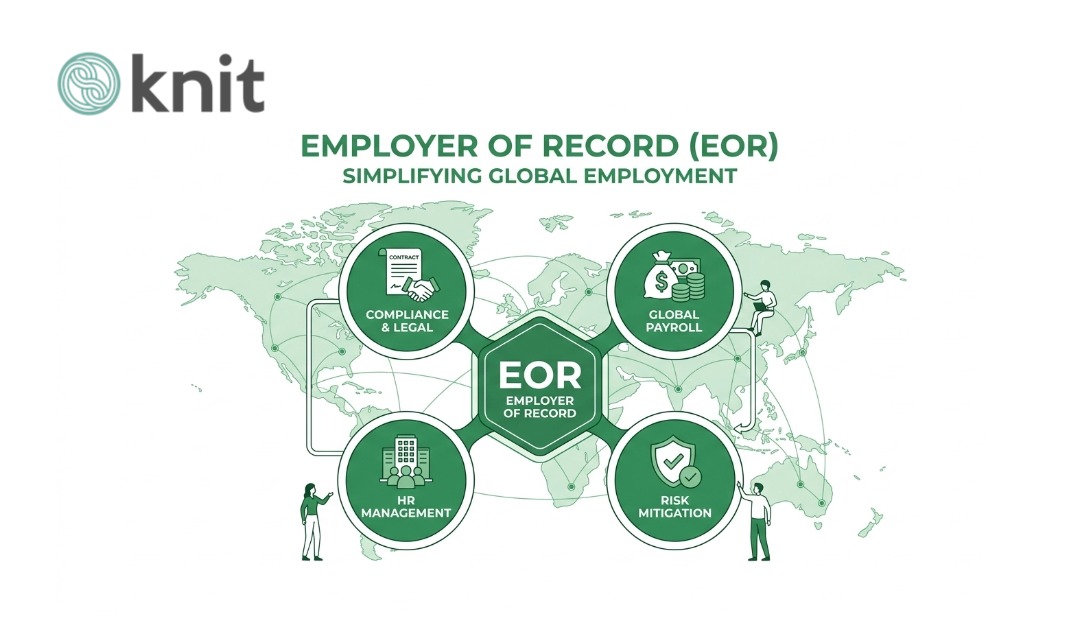
An Employer of Record model is built precisely to absorb the execution burden of the three pillars described above, without requiring the foreign company to establish a WFOE or build a standalone HR compliance function in China. Under Knit's EOR China service, this typically breaks down as follows.
Contracts: Knit acts as the legal employer of record, which means Knit drafts, issues, and executes the labor contract in compliant Chinese-language form, selects the correct contract type based on the role and the employee's service history, tracks the one-month signing clock, and manages the renewal and open-term-trigger calculations across the employment relationship.
Handbooks: Knit maintains and administers a compliant handbook framework — including the democratic procedure and communication steps described in Section 5 — that governs the employees on Knit's China platform. Importantly, this does not mean Knit substitutes its own generic judgment for the client's business needs: the client company still defines its own performance standards, escalation logic for underperformance, and disciplinary priorities, because those are business decisions specific to the client's operations. Knit's role is translating that substance into a handbook structure that will hold up procedurally if challenged, and executing the adoption and acknowledgment process correctly.
Approvals and filings: Knit handles labor contract and social insurance/housing fund registration within the applicable local bureau windows, secures working-hours system approvals where a client's operational needs call for a comprehensive or non-fixed schedule, and — where the engagement involves foreign nationals working inside China — coordinates the work and residence permit process end to end.
Knit practical tip #4 (bonus): Even under a full EOR arrangement, the fastest path to a compliant termination-for-cause outcome later is for the client to document performance and conduct issues contemporaneously — in writing, dated, and specific — rather than relying on the handbook's existence alone. Arbitrators weigh both the rule's validity and the evidence that the specific violation occurred; Knit can guarantee the former, but the latter still depends on how the client's on-the-ground managers document day-to-day issues as they happen.
8. Common Mistakes When Copy-Pasting a Home-Country Template
Foreign companies expanding into China frequently start by adapting an existing labor contract or handbook template from their home jurisdiction or a nearby market where they already operate. This shortcut introduces predictable failure points.
- Importing "at-will" termination language. Templates from the United States and several other jurisdictions include at-will termination clauses that have no legal effect in China and can actively undermine an employer's position by suggesting a termination framework that contradicts PRC law's exhaustive, ground-specific approach.
- Treating the handbook as a static translated document. A handbook translated word-for-word from a headquarters policy, without running it through the democratic procedure and communication steps, looks complete but carries none of the enforceability the original document had at home.
- Underspecifying working hours. Home-country templates often assume a working-hours default that doesn't map cleanly onto China's standard/comprehensive/non-fixed framework, leaving contracts silent on a clause that Chinese law expects to be explicit — and leaving employers exposed to overtime claims calculated under the standard system by default.
- Omitting or understating probation pay mechanics. Many home markets don't cap probation pay as a percentage of confirmed-employee salary; templates imported wholesale frequently miss this requirement entirely, or apply a flat percentage that doesn't account for the "highest of three benchmarks" rule.
- Assuming one national template covers every city. Registration procedures, minimum wage floors used in probation-pay and overtime calculations, and even certain procedural expectations for handbook communication vary by locality; a single national template without local adaptation frequently under- or over-complies depending on the city.
9. Frequently Asked Questions
Do we need a separate contract type for senior executives?
Not necessarily a different contract type, but senior executives often warrant a non-fixed working-hours system given genuinely variable schedules — which requires separate prior labor bureau approval and should be reflected explicitly in the contract's working-hours clause.
Can we avoid the double-wage penalty by backdating a contract?
No. Backdating a labor contract to conceal a missed signing deadline is a falsification risk in itself and does not eliminate the underlying wage liability if the true start date can be established through other records, such as payroll or access logs.
Is a handbook acknowledgment email enough to satisfy the communication requirement?
An email alone is weaker evidence than an individually signed acknowledgment or a logged intranet posting with proof of access; the safer approach is a signed receipt for each employee, retained in their personnel file.
If we use an EOR, whose employees are they for handbook purposes?
Under Knit's EOR structure, Knit is the legal employer and administers the compliant handbook framework, while the client retains full authority over the substantive performance and conduct standards that feed into that framework.
How often should a handbook be re-adopted through democratic procedure?
Any material change to provisions affecting employee interests — compensation structure, disciplinary grounds, leave policy, and similar — generally requires re-running the democratic procedure and communication steps for that revised content, not just a one-time adoption at hiring.
Does the one-month signing rule apply to task-based contracts too?
Yes. The one-month signing deadline and the associated double-wage exposure apply regardless of which of the three contract types the employer intends to use.
Do foreign national work permits need to be renewed alongside the labor contract?
Generally yes — work and residence permits for foreign nationals typically carry their own validity periods and renewal timelines that need to be tracked separately from, though in coordination with, the underlying labor contract term.
10. Glossary of Key Terms
- Workplace Rules / Employee Handbook): The internal rules governing compensation, discipline, working hours, leave, and termination grounds; enforceable only when adopted through democratic procedure and properly communicated to employees.
- Democratic Procedure: The required consultation process — discussion with and solicited opinions from the employee representative congress or all staff — that workplace rules affecting employee interests must go through before they can be lawfully enforced.
- Open-Term Contract: A labor contract with no fixed end date, mandatory to offer after two consecutive fixed-term renewals or ten years of cumulative service, and terminable only on statutory grounds.
- Fixed-Term Contract: A labor contract with a defined start and end date; the most common contract type for new hires in China.
- Comprehensive Working-Hours System: A working-hours arrangement that averages hours over a longer cycle than the standard week, typically used for shift-based operations, and requiring prior local labor bureau approval.
- Employer of Record (EOR): A third-party legal employer that hires staff on a client company's behalf in a jurisdiction where the client has no local entity, handling contracts, payroll, and statutory compliance while the client directs day-to-day work.
About Knit
Knit People is a global compliance employment and payroll provider founded in Canada in 2015, with a leadership and delivery team built around professional accountants. Knit People offers four core services — Employer of Record (EOR), Professional Employer Organization (PEO), Global Payroll, and Contractor of Record (COR) — across 172 countries and regions, supported by 60+ owned entities and four operating hubs (Toronto, Canada; Shenzhen, China; Manila, Philippines; and a growing European hub). Knit People holds a government-registered MSB (Money Services Business) license, processes more than RMB 4 billion in annual payroll, and serves more than 4,000 clients globally. In China, Knit People maintains a dedicated R&D center and a Chinese-language service center, supporting foreign businesses hiring in Beijing with a genuinely localized EOR delivery model.
Website: knitpeople.com | Contact: hello@knitpeople.com
Disclaimer
Knit is not a law firm, and this article is for general informational purposes only. Labor contract and handbook enforceability standards — including what counts as adequate democratic procedure and communication — can vary by locality and depend heavily on the specific facts of each case and the practices of the local labor arbitration body involved. Companies should confirm exact current requirements with Knit or a licensed local professional before finalizing contracts, handbooks, or termination decisions.





.svg)
.svg)
.svg)
.svg)
.svg)