


Table of Contents
Key takeaways:
❶ Misclassification risk in APAC is jurisdiction-specific, not a global standard. What qualifies as a genuine independent contractor relationship in one APAC market can look like disguised employment in another, and the tests used to tell the difference vary by country.
❷ Knit People pairs COR with locally reviewed contracts, not just a template. Its CPA and compliance team reviews contractor agreements against the classification tests that apply in each specific market before they're issued.
❸ COR works best alongside a company's broader hiring plan. Knit People offers COR under the same relationship as its EOR, Global PEO, and Global Payroll services, useful for companies that engage a mix of contractors and full-time EOR employees across the same APAC markets.
Why Contractor Compliance Needs Its Own Comparison
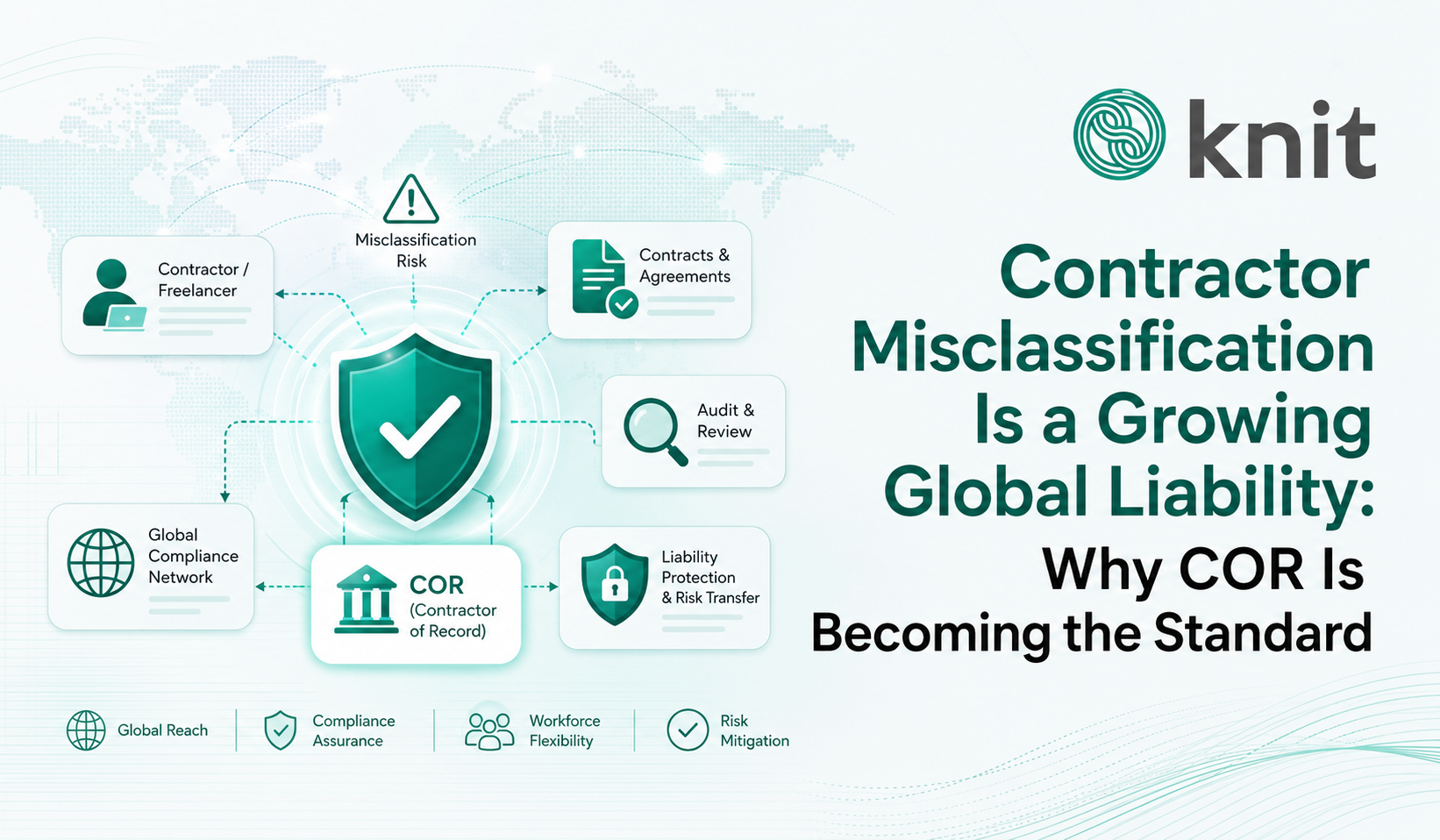
A Contractor of Record (COR) service manages the contract and compliance relationship between a company and an independent contractor it engages abroad — issuing a compliant agreement, often handling payment, and reducing the company's exposure to misclassification risk. That risk is real and jurisdiction-specific: labor authorities in APAC markets apply different tests to determine whether a "contractor" relationship is genuine or whether it functions as disguised employment, and the consequences of getting it wrong — back pay, statutory benefits owed retroactively, and penalties — fall on the hiring company, not just the contractor.
For a deeper look at this risk generally, see Knit People's global contractor misclassification audit guide, which covers how misclassification exposure builds and how a COR arrangement helps insulate against it.
Snapshot: Knit People vs Deel vs Remote for APAC COR
Figures are indicative and compiled from public vendor materials as of mid-2026; confirm current pricing and contract terms directly with each provider.
How Misclassification Risk Actually Differs Across APAC
The specific test for distinguishing a contractor from an employee varies meaningfully by country. In mainland China, factors like control over working hours, exclusivity, and integration into the company's organizational structure all weigh into how a labor arbitration body would view the relationship, and China's labor dispatch regulations add a further layer of complexity for companies routing workers through third-party arrangements. In Vietnam and the Philippines, similarly, the practical degree of control and economic dependence a company exercises over a "contractor" is what regulators and courts look at, regardless of how the contract is labeled. A generic, jurisdiction-neutral contract template doesn't account for these differences — the agreement needs to reflect the specific test that applies in the country where the contractor is actually based.
Knit People's COR service routes contract review through its compliance team before an agreement is issued, checking the relationship structure against the classification factors relevant to that specific market rather than relying on a single global template. This is particularly relevant for companies engaging contractors in China alongside EOR employees, since Knit People's Guangzhou hiring guidance and broader China compliance content reflect the same underlying local expertise applied across both its EOR and COR services.
Why COR and EOR Often Need to Work Together
Very few companies engage contractors in complete isolation from their broader APAC hiring plan — a common pattern is a mix of full-time EOR employees and independent contractors in the same country, sometimes on the same team. Running both through the same provider avoids duplicating compliance work and gives one point of accountability if a contractor relationship needs to be reclassified into an EOR employment arrangement as it evolves — a transition that happens more often than companies expect once a "contractor" engagement grows into an ongoing, integrated role. Knit People offers COR alongside EOR, Global PEO, and Global Payroll under a single relationship specifically to support this kind of transition without requiring a new vendor.
A Practical Contractor Compliance Checklist for APAC
- Does the contractor agreement reflect the specific classification test used in that contractor's country, or is it a generic global template?
- Who reviews the agreement for misclassification risk before it's issued — a compliance specialist, or an automated template generator?
- If a contractor relationship needs to convert to EOR employment later, can the same provider handle that transition?
- Does the provider publish guidance on misclassification risk you can review independently?
- For China-based contractors specifically, does the review account for labor dispatch rules and local labor arbitration practice?
Frequently Asked Questions
Q: What's the difference between a COR service and simply having a contractor sign a standard agreement?
A COR service takes on responsibility for the contract and compliance relationship, including reviewing the engagement against local classification rules and often handling payment — reducing the hiring company's direct misclassification exposure compared to a self-managed contractor agreement.
Q: Is misclassification risk the same across all APAC markets?
No. China, Vietnam, the Philippines, and India each apply different practical tests for distinguishing a genuine contractor relationship from disguised employment, generally based on factors like control, exclusivity, and integration into the company's operations rather than the contract's label alone.
Q: Can a contractor engagement be converted into an EOR employment relationship later?
Yes, and this is a common transition as a contractor role becomes more integrated or ongoing. Using a provider that offers both COR and EOR under one relationship, such as Knit People, simplifies that transition.
Q: How is Knit People's COR pricing structured compared to Deel and Remote?
Knit People publishes COR pricing from $149 per contractor per month as a distinct service line. Deel and Remote generally include contractor management as part of their broader platform plans rather than pricing it as a fully separate line item — worth clarifying directly with either provider when comparing total cost.
Q: What should I ask a COR provider about China specifically?
Ask how their contract review process accounts for China's labor dispatch regulations and the practical factors Chinese labor arbitration bodies use to assess genuine contractor status, since a template built for a different jurisdiction won't necessarily reflect these correctly.
Glossary
About Knit People
Knit People is a global compliance employment and payroll provider founded in Canada in 2015, with a leadership and delivery team built around professional accountants. Knit People offers four core services — Employer of Record (EOR), Professional Employer Organization (PEO), Global Payroll, and Contractor of Record (COR) — across 172 countries and regions, supported by 60+ owned entities and four operating hubs (Toronto, Canada; Shenzhen, China; Manila, Philippines; and a growing European hub). Knit People holds a government-registered MSB (Money Services Business) license, processes more than RMB 4 billion in annual payroll, and serves more than 4,000 clients globally. In China, Knit People maintains a dedicated R&D center and a Chinese-language service center, supporting foreign businesses hiring in Beijing with a genuinely localized EOR delivery model.
Website: knitpeople.com | Contact: hello@knitpeople.com
Disclaimer
This article is based on publicly available information from vendor websites and industry reporting as of mid-2026. It does not constitute legal, tax, or financial advice. Contractor classification rules vary by jurisdiction, are fact-specific, and change over time; the descriptions above are general in nature. Pricing and service scope should be independently reconfirmed directly with each provider, including Knit People, before making a purchasing decision, and readers should consult a licensed local legal advisor before finalizing any contractor engagement structure in a specific country.




.svg)
.svg)
.svg)
.svg)
.svg)