Table of Contents
The short answer: On October 14, 2026, the Department of Homeland Security (DHS) published a proposed rule to remove 8 CFR 214.1(c)(5). That provision currently tells U.S. Citizenship and Immigration Services (USCIS) to defer to its earlier approval when the same employer files a Form I-129 extension for the same worker on the same facts. Without it, employers filing extensions for H-1B, L-1, O-1, E and TN workers would need to prove eligibility again from scratch. Officers could still look at prior approvals, but those approvals would no longer be the starting point. The rule is not final: comments close on November 13, 2026, and the current deference rule still applies. DHS expects requests for evidence (RFEs) to rise by about 2.9 percentage points, and petitions that get an RFE take a median of 76 days to decide, compared with 12 days for those that don't. Employers should treat every extension like a new petition and file early.
Key takeaways
- Status: proposed rule only. Comments close November 13, 2026, and there's no final rule or effective date yet.
- What changes: USCIS would no longer defer to prior approvals, so employers carry the full burden of proof at every extension.
- Who's affected: all I-129 extensions, mainly same-employer, same-role filings. DHS puts this at about 208,000 petitions a year, roughly 30% of I-129 volume.
- How much: about 6,044 additional RFEs a year. DHS found no matching change in denial rates.
- What to do: document each extension as if it were new, check what has changed since the last approval, file up to six months early, and use premium processing where timing is tight.
H-1B extension rule at a glance (as of October 21, 2026)
- Proposed rule: would remove 8 CFR 214.1(c)(5), with comments due November 13, 2026. Federal Register: Removing Deference to Prior USCIS Determinations of Eligibility (91 FR 65119)
- How to comment: online only, docket USCIS-2026-0529. Regulations.gov
- Current rule: USCIS defers to prior approvals involving the same parties and facts unless there was a material error, a material change or new adverse information. 8 CFR 214.1
1. What has DHS proposed?
The USCIS deference policy means that when the same employer files an I-129 extension for the same worker on unchanged facts, USCIS generally accepts its earlier finding of eligibility. It departs from that finding only if it identifies a material error, a material change or new adverse information.
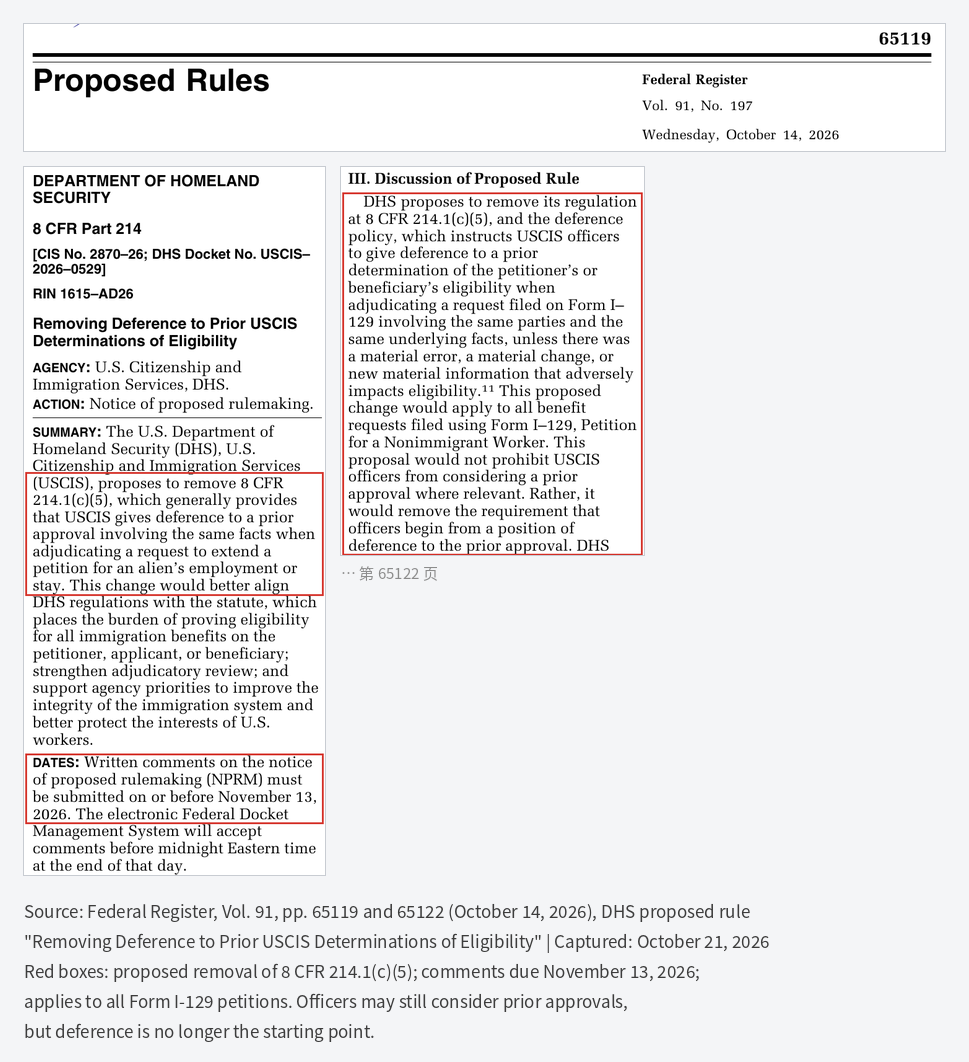
DHS argues that the law always puts the burden of proving eligibility on the petitioner, but the deference rule shifts it onto officers, who have to find an error or a change before they can depart from a prior approval. DHS also cites site-visit data. While deference was in place (FY2022–2025), 22.39% of H-1B extension site visits found noncompliance or fraud, compared with 16.77% when it wasn't (FY2018–2020). DHS acknowledges that this comparison alone doesn't prove cause and effect.
2. Where did the deference policy come from?
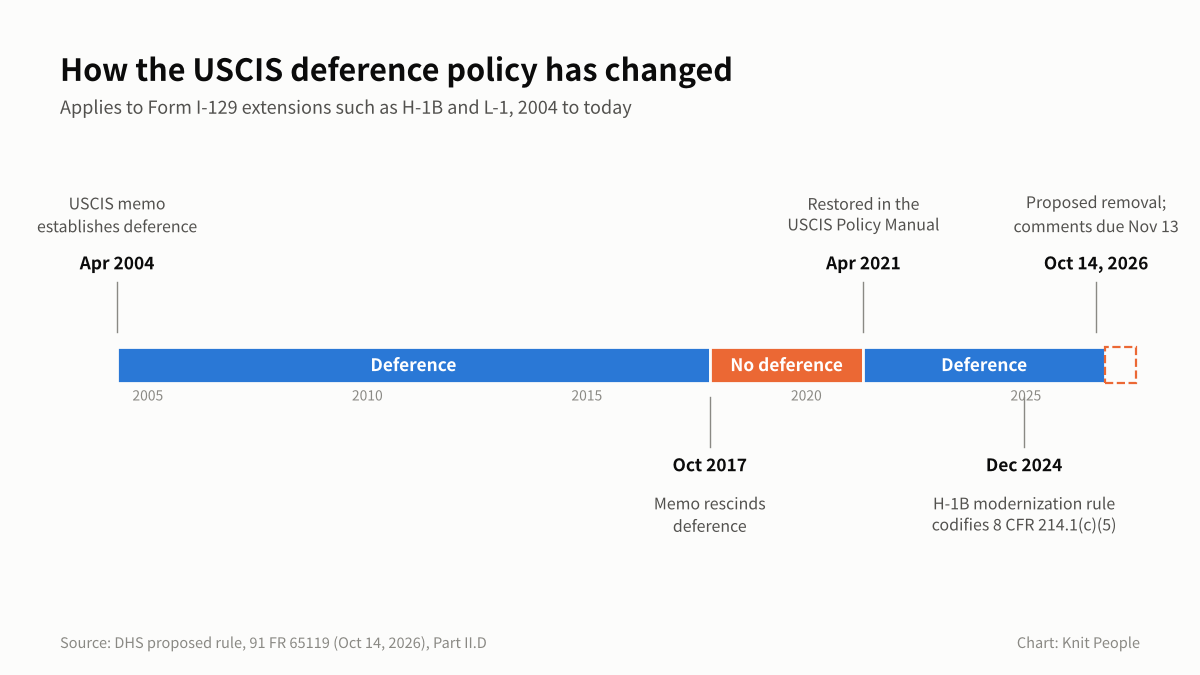
The difference from 2017 is that deference is now written into federal regulations. Removing it takes full notice-and-comment rulemaking, not just a policy memo.
3. How would extension reviews change?
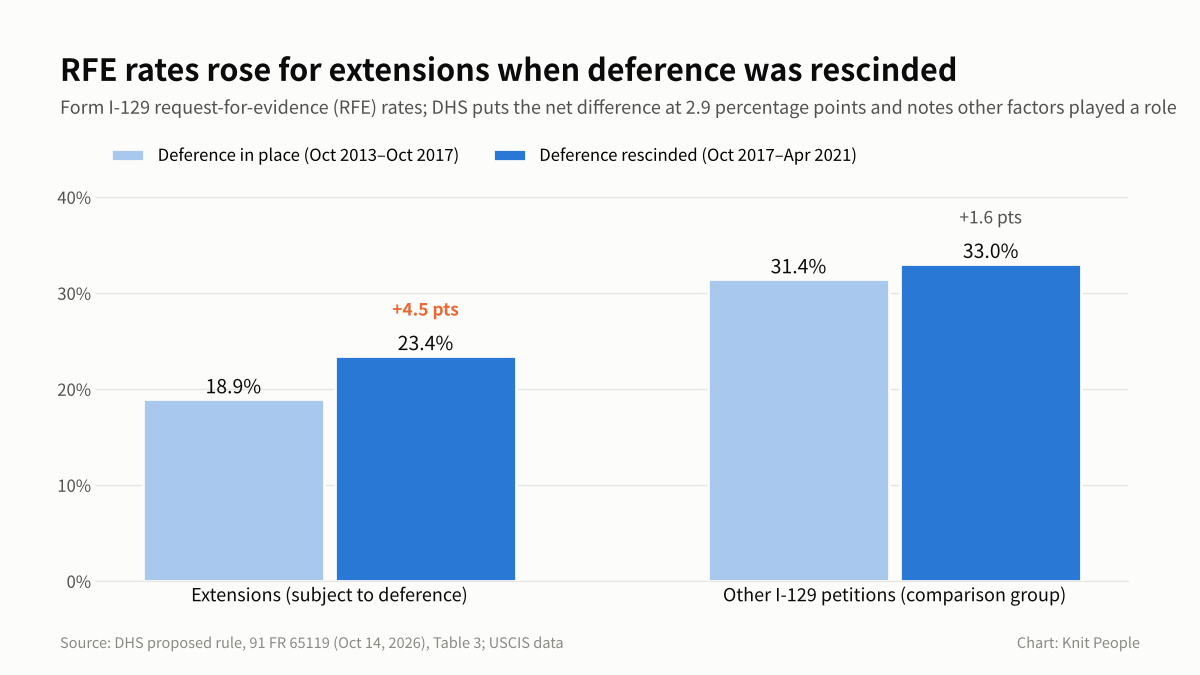
DHS based its estimates on 2017–2021, when deference was rescinded:
Expect officers to look again at the points every extension has to prove:
- The role: whether it is still a specialty occupation and whether the degree requirement matches the duties.
- The employment relationship: whether the job is real, and whether the work location and reporting lines are clear.
- Wages: whether you're paying at least the wage on the Labor Condition Application (LCA).
- Maintenance of status: whether the employee has worked under the approved terms throughout.
- L-1A managerial capacity: whether the team or function being managed is real and the org chart supports it.
On top of this, a USCIS policy alert issued August 5, 2026 (PA-2026-05) allows officers to deny a petition without first issuing an RFE when evidence is insufficient. Taken together, the two changes mean you need to get the filing right the first time.
4. What are the risks for your H-1B employees?
A previous approval no longer guarantees the next one. Issues that went unchallenged before, such as a vague job description or a loose link between the degree and the role, could be raised at extension.

5. What should you include in an extension petition?
On timing:
- File early. You can file up to six months before the extension start date, so use that window.
- Consider premium processing if the employee needs to travel or the I-94 is close to expiring.
- Allow for RFEs. Budget one to two months to respond and another one to two months for a decision.
- Keep a tracker. Record each employee's I-94 expiry, approval end date, LCA validity and next filing date.
6. The rule isn't final. What should you do now?
Comments can only be submitted through Regulations.gov and are published, so leave out any employee personal data. Strategy for individual cases should be decided with a licensed U.S. immigration attorney.
7. The bottom line
DHS has proposed removing the rule that tells USCIS to defer to prior approvals on I-129 extensions, which means H-1B, L-1 and similar extensions would have to prove eligibility again. The rule is open for comment until November 13 and isn't in force yet, and DHS expects RFE rates to rise by about 2.9 percentage points. To prepare:
- Review foreign national employees whose status expires in the next 6–12 months, and file early where you can.
- Document every extension as a new petition, covering the role, degree, wages and maintenance of status.
- Watch for the final rule's effective date and transition rules, and get case-specific advice from immigration counsel.
8. About Knit People
Knit People was founded in Canada in 2015 and began as a global payroll provider. It runs four operations centers, in Canada, China, the Philippines and Europe, and holds a government-registered MSB license. Its core services are employer of record (EOR), professional employer organization (PEO), global payroll and contractor of record (COR). It also offers recruitment, entity setup, tax compliance, benefits administration and work visa support. Knit People combines regional operations centers with in-country experts. It covers 172 countries and regions, has served more than 4,000 companies and 12,000 employees, and processes over RMB 4 billion in payroll a year.
9. FAQ
Q1:Has the H-1B extension deference rule been removed?
Not yet. DHS published a proposed rule on October 14, 2026, and comments close on November 13, 2026. A final rule would still need to be issued before anything changes. For now, 8 CFR 214.1(c)(5) remains in effect.
Q2:What would change for extensions without deference?
USCIS would no longer start from its prior approval when deciding a same-employer, same-role extension. Employers would have to prove again that the role, degree, wages and employment relationship meet the requirements, though officers could still consider prior approvals. DHS expects RFE rates to rise by about 2.9 percentage points.
Q3:Which visa categories are affected?
The rule covers all petitions filed on Form I-129. The main impact is on same-employer extensions, including H-1B, L-1, O-1, E-1, E-2, E-3 and TN.
Q4:Can an employee keep working while an H-1B extension is pending?
If the extension was filed on time, the employee can generally keep working for the same employer for up to 240 days after the I-94 expires. If the extension is denied, they must stop working.
Q5:What should employers do now?
Review foreign national employees whose status expires in the next 6–12 months and file extensions early. Prepare each filing as a new petition, with an updated job description, the degree-to-role link, the LCA, pay stubs and an org chart. Then watch for the final rule's effective date and transition rules.
10. Sources
- Federal Register: Removing Deference to Prior USCIS Determinations of Eligibility (91 FR 65119, October 14, 2026) (accessed October 21, 2026)
- GovInfo: Federal Register PDF (accessed October 21, 2026)
- Regulations.gov: Docket USCIS-2026-0529 (accessed October 21, 2026)
- eCFR: 8 CFR 214.1 (accessed October 21, 2026)
- American Bazaar: DHS proposal ends deference to prior H-1B approvals (October 13, 2026) (accessed October 21, 2026)
Update log
- October 27, 2026: First published (proposed rule stage)
Disclaimer: This article is based on the Federal Register and other public sources. It is for general information only and is not legal advice. The rule is not yet in effect, and the final rule may differ. For individual cases, please consult a licensed U.S. immigration attorney.