


Table of Contents
Key takeaways:
① This guide is for international business leaders and HR directors who have already decided to hire in China and now need to understand the operational realities — city-by-city cost differences, the four legal pathways available to foreign companies, employee data privacy obligations under China's PIPL, non-compete enforceability, and how to benchmark a competitive benefits package for the Chinese market.
② China is not a single hiring market. A compensation package designed for a sales manager in Shanghai will have materially different social insurance obligations, tax implications, and competitiveness benchmarks than the same role in Chengdu, Shenzhen, or Wuhan — and getting these details wrong creates both compliance exposure and talent-retention risk.
③ This complete guide cuts through the complexity: it documents every major alternative to EOR available to foreign companies hiring in China, explains where each approach breaks down, and shows precisely how Knit People's Employer of Record service covers the operational gaps that standard market-entry guides leave unaddressed.
Table of Contents
- 1. The Four Legal Pathways for Hiring in China — and Why Three of Them Fall Short
- 2. China Is Not One Market: City-by-City Hiring Differences That Matter
- 3. The True Cost of Employing Someone in China: A Full Breakdown
- 4. Employee Data Privacy in China: What PIPL Means for Your HR Processes
- 5. Non-Compete and Confidentiality Agreements: What Actually Holds Up in China
- 6. Benefits Benchmarking: What Chinese Employees Actually Expect
- 7. Hiring Foreign Nationals in China: A Different Set of Rules
- 8. How Knit People Manages the Full Complexity — Not Just the Basics
- 9. Article Summary and Key Takeaways
- About Knit People
- Disclaimer

1. The Four Legal Pathways for Hiring in China — and Why Three of Them Fall Short
When an international company decides to build a team in China before establishing a Wholly Foreign-Owned Enterprise (WFOE), they typically encounter four options. Understanding not just what each option allows, but where each one fails, is essential for making the right structural decision.
Option 1: Employer of Record (EOR)
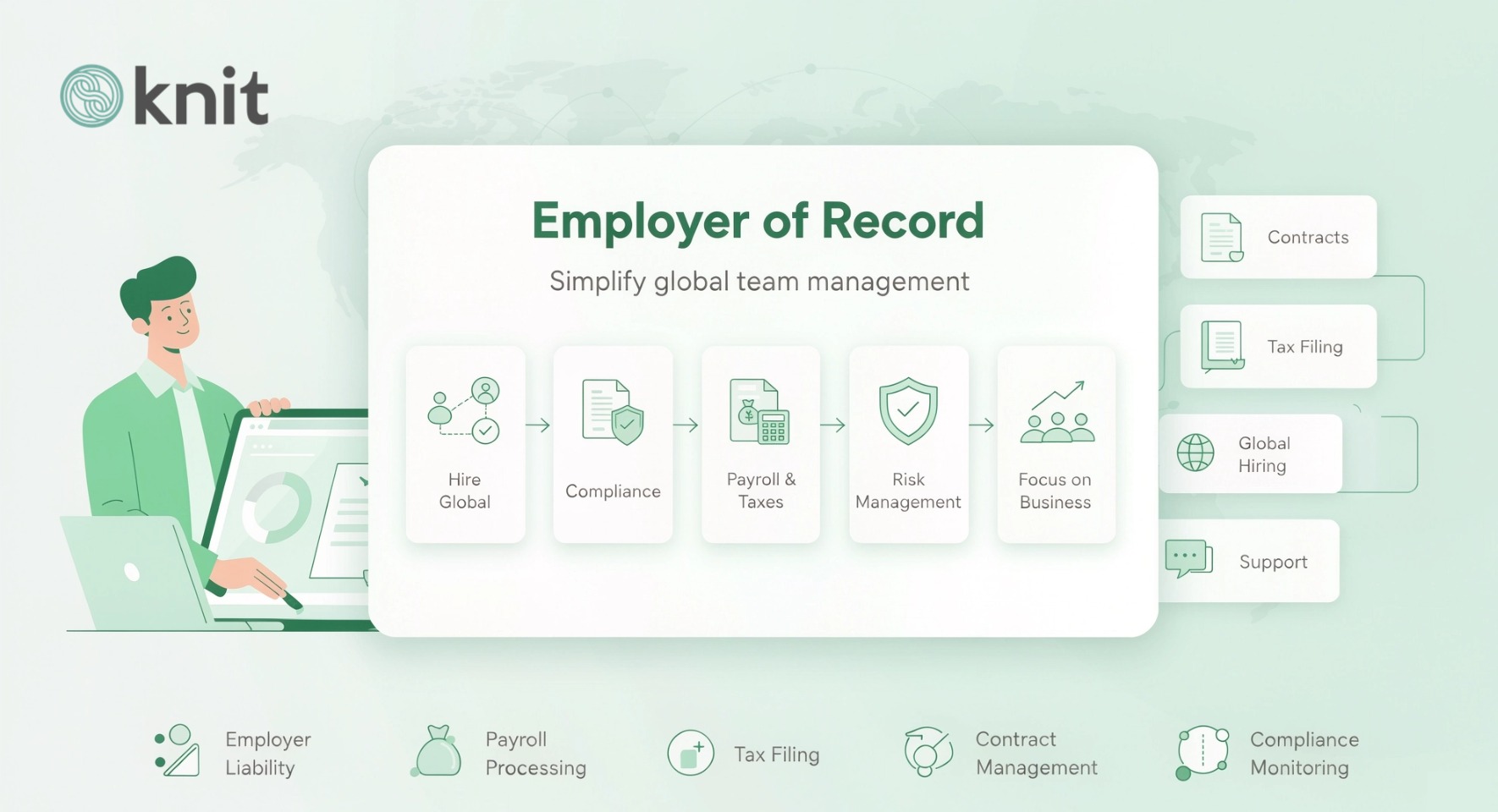
An EOR provider holds its own legal entity in China and employs your chosen candidate as a legally compliant, direct employee — signing the labor contract, running payroll, enrolling social insurance, and handling all statutory filings on your behalf. You retain full management of the employee's work. No Chinese business registration is required on your side.
This is the only option on this list that combines full legal compliance, operational speed, and genuine scalability for foreign companies without a Chinese entity.
Option 2: Representative Office (RO)
A Representative Office is a registered presence in China that allows a foreign company to conduct market research, liaison activities, and relationship-building — but not direct business operations or revenue-generating activities. Importantly, an RO cannot sign commercial contracts with Chinese clients, cannot issue Chinese VAT invoices, and cannot collect RMB revenue.
On the employment side: a Representative Office is technically permitted to hire Chinese staff, but under Chinese regulations, Chinese nationals employed through an RO must be seconded through a government-designated labor dispatch agency (通常为外企服务公司 / FESCO or similar). This means:
- The labor dispatch agency — not the RO — is the legal employer of the Chinese employees
- The RO pays service fees to the dispatch agency, which include the employee's salary plus a service markup
- The RO has limited direct contractual relationship with the employees under Chinese labor law
- Dispatch arrangements for Chinese RO employees carry the inherent compliance risks of labor dispatch (see Option 3 below)
Bottom line on ROs: Suitable for pure liaison functions with a very small headcount. As soon as your China presence involves anything resembling commercial operations or a meaningful team size, an RO's legal and employment limitations become significant constraints.
Option 3: Labor Dispatch
Labor dispatch — hiring workers through a licensed Chinese staffing agency that acts as the formal employer — was historically a common workaround for foreign companies without Chinese entities. China's 2013 amendments to the Labor Contract Law and subsequent regulations dramatically curtailed its legitimate use:
- Dispatch workers may only be used in positions that are temporary (less than 6 months), auxiliary (not core business functions), or substitutive (covering for an absent regular employee)
- The proportion of an employer's workforce on dispatch arrangements may not exceed 10% of the total headcount
- Dispatch workers must receive equal pay for equal work compared to directly employed counterparts in the same role
In practice, international companies that attempt to use labor dispatch as a primary hiring mechanism for core business roles — sales managers, engineers, regional directors — are operating in a gray area with growing enforcement risk. Labor arbitration tribunals have increasingly ruled that substantive employment relationships exist regardless of the formal dispatch structure, particularly where the dispatched employee works exclusively under the client company's management for an extended period.
Bottom line on labor dispatch: Legitimate for narrow, time-limited, truly auxiliary roles. Not a sustainable or legally sound primary hiring mechanism for core business functions.
Option 4: Hiring as an Individual Contractor
Some international companies attempt to engage Chinese workers as independent contractors — signing a services agreement rather than a labor contract, paying a fixed fee, and treating the arrangement as a business-to-individual transaction rather than an employment relationship.
China's regulatory framework strongly disfavors this approach for substantive working relationships. The test is substance, not form: if the working arrangement involves regular working hours, a single client, employer-directed work, integration into the company's operations, and economic dependence — it will be treated as employment regardless of how the contract is labeled.
The consequences of contractor misclassification in China are severe:
- Retroactive social insurance contributions — back-payment of both employer and employee sides for the full duration of the arrangement
- IIT withholding liability — potential personal liability for the Chinese "contractor" who failed to pay IIT on what should have been employment income
- Labor law protections applying retroactively — statutory notice periods, severance entitlements, and in some cases, entitlement to an open-ended contract
Bottom line on contractor arrangements: Appropriate only for genuinely project-based, short-term, multi-client engagements. For any ongoing, directed working relationship — especially with a single foreign company — this approach carries meaningful legal and financial risk.
Why EOR Is the Structurally Sound Choice
An EOR arrangement is the only option that:
- Creates a fully compliant employment relationship from day one
- Does not require a Chinese business registration on your side
- Operates at scale (multiple employees, multiple cities, ongoing engagements)
- Keeps the compliance risk with a specialist provider rather than distributing it across informal arrangements
- Can be unwound cleanly and transitioned to a WFOE when the time is right
2. China Is Not One Market: City-by-City Hiring Differences That Matter
One of the most common mistakes international HR directors make when approaching China hiring is treating "China" as a single, uniform employment market. In reality, the variables that determine your total employment cost, compliance obligations, and talent competitiveness shift materially across cities.
Here is a breakdown of the key dimensions where city-level differences have direct operational impact.
2.1 Social Insurance Contribution Rates and Bases
Social insurance in China is administered at the municipal level. Each city sets its own:
- Contribution base lower and upper limits — updated annually, typically based on the previous year's average local salary data. The base determines the minimum and maximum salary amount on which contributions are calculated.
- Contribution rates by program (pension, medical, unemployment, workplace injury, maternity)
Illustrative comparison (2025–2026 figures, approximate):
Note: All figures are illustrative and approximate. Rates and bases are updated annually by each city's social insurance authority. Knit People's payroll compliance engine reflects the current applicable rates for each city in which we manage employees.
The practical implication: hiring the same employee at the same gross salary in Shenzhen vs. Shanghai can result in an employer-side social insurance cost difference of approximately 5–7 percentage points — a material budget variance at scale.
2.2 Housing Provident Fund (HPF)
HPF contribution requirements also vary by city. Contribution rates for both employer and employee typically range from 5% to 12% of monthly salary, with city-specific caps. Some cities have historically allowed companies to apply for reduced contribution rates during periods of financial difficulty; HPF exemptions for foreign companies vary and should be confirmed city by city.
2.3 Minimum Wage
China's minimum wage is set at the provincial and municipal level, with cities within a province sometimes having differentiated rates. The gap between minimum wages across Chinese cities is significant:
- Shanghai has historically maintained the highest minimum wage among major cities (approximately RMB 2,690/month as of mid-2025)
- Tier 2 and Tier 3 cities may have minimum wages 30–50% below Shanghai levels
For international companies offering competitive salaries well above minimum wage, this is less of a direct constraint — but for base-level roles or local market positions, minimum wage compliance requires city-level verification.
2.4 Local Talent Market Competitiveness
Salary benchmarks, talent availability, and the competitive intensity of recruitment vary dramatically across China's hiring markets:
- Shanghai and Beijing have the deepest pools of internationally experienced professionals, bilingual candidates, and senior executives — and the most competitive salary expectations
- Shenzhen and Guangzhou are strong markets for technology, manufacturing, and supply chain talent, with a dynamic startup ecosystem and competitive mid-market salaries
- Chengdu, Wuhan, Xi'an offer access to large university graduate populations, growing technology sectors, and meaningfully lower salary expectations for comparable roles — an increasing number of international companies are establishing regional operations in these cities precisely for the talent cost advantage
Knit People operates in all of these markets, with city-specific payroll compliance expertise and local market benchmarking support to help you structure a competitive, compliant compensation package wherever your hire is based.
3. The True Cost of Employing Someone in China: A Full Breakdown
International companies consistently underestimate the total cost of employing someone in China. The common error is budgeting only the gross salary. Here is the complete picture.
3.1 Employer-Side Mandatory Contributions
On top of every employee's gross monthly salary, you will incur:
Social Insurance (employer side): Approximately 23–30% of gross salary depending on the city, as illustrated in Section 2.1.
Housing Provident Fund (employer side): Typically 5–12% of monthly salary up to the local HPF base ceiling. Many international companies contribute at the standard local rate; the HPF amount is paid into a dedicated account held in the employee's name and can be withdrawn for housing-related purposes.
Combined mandatory employer contribution as a percentage of gross salary: Approximately 28–42% in most major cities, when both social insurance and HPF are included.
3.2 Illustrative Total Employment Cost — Shanghai Example
All figures are illustrative. Actual amounts depend on the city, the employee's salary level relative to local contribution base caps, and current applicable rates.
3.3 One-Time and Variable Costs
Beyond the recurring monthly cost, factor in:
- Statutory annual bonus / 13th month: Not legally mandatory across China as a national requirement, but common practice in many industries and regions — and once established as a customary practice in your company, it can be argued to be a contractual entitlement. Many international companies budget one month's additional salary as a year-end performance bonus.
- Severance accrual: For planning purposes, budget one month's salary per year of service as a contingent liability for each employee. This reflects China's statutory severance for N+1 termination scenarios.
- Recruitment costs: If using Knit People's global headhunting service, typical recruitment fees for professional roles in China range from 15–25% of annual salary. These are one-time, paid upon successful placement.
4. Employee Data Privacy in China: What PIPL Means for Your HR Processes
China's Personal Information Protection Law (PIPL), effective November 2021, is one of the strictest personal data protection frameworks in the world — comparable in scope to the EU's GDPR, but with specific provisions that create unique compliance obligations for international businesses managing Chinese employees.
4.1 What Data Is Covered
PIPL defines "personal information" broadly: any information related to an identified or identifiable natural person. For HR purposes, this covers essentially all standard employee data — name, ID number, salary, bank account, health records, performance assessments, location data, and communications content.
"Sensitive personal information" — which includes biometric data, health and medical information, financial information, and religious beliefs — requires a separate, explicit legal basis for processing and heightened protection standards.
4.2 The Cross-Border Data Transfer Requirement
This is the provision that catches most international companies off guard. Under PIPL, transferring Chinese employees' personal information outside of China — including to a headquarters HR system in the US, EU, or elsewhere — requires one of the following:
- Passing a government security assessment (mandatory for organizations handling the personal data of more than 1 million people, or for transfers of particularly sensitive categories)
- Obtaining a personal information protection certification from an accredited institution
- Concluding a standard contract with the overseas recipient, based on a template issued by China's Cyberspace Administration of China (CAC) — with a mandatory filing requirement for most organizations
For a typical international company using a global HRIS (such as Workday, SAP SuccessFactors, or BambooHR) that is hosted outside China, syncing Chinese employee data to that system constitutes a cross-border data transfer under PIPL and requires a compliant legal mechanism.
What this means in practice: International companies onboarding Chinese employees through an EOR need to ensure that their data-sharing arrangements with the EOR provider, and the EOR's own data transfer practices, comply with PIPL. Knit People's data processing architecture is designed with PIPL compliance in mind, and our standard service agreement includes appropriate data processing provisions for cross-border transfer scenarios.
4.3 Employee Consent and Notice Requirements
PIPL requires employers to provide employees with clear notice of what personal information is collected, for what purpose, and to whom it may be disclosed. Collection of employee personal information requires either a valid legal basis (such as necessity for the performance of an employment contract) or explicit informed consent for data uses beyond that necessity.
For international companies, this means: employee handbooks, privacy notices, and onboarding documentation used in China should be reviewed by a PIPL-informed specialist before deployment — not simply translated from a global template.
5. Non-Compete and Confidentiality Agreements: What Actually Holds Up in China
Non-compete and trade secret protection are areas where international companies frequently import assumptions from their home jurisdictions that do not translate accurately to China's legal framework.
5.1 Non-Compete Clauses in China
China's Labor Contract Law explicitly addresses non-compete agreements (竞业限制). Key rules:
Eligibility: Non-compete obligations may only be imposed on employees who have access to the employer's trade secrets or confidential information — specifically: senior management (高级管理人员), senior technical personnel (高级技术人员), and other employees with confidentiality obligations. Non-compete clauses imposed on employees who do not fall into these categories may be unenforceable.
Mandatory compensation: A non-compete clause is only enforceable if the employer pays the employee a non-compete compensation during the restricted period — at a minimum equivalent to the average of the employee's last 12 months' salary (typically interpreted as at least 30% of monthly salary by local courts, with some jurisdictions setting higher floors). Failing to pay this compensation renders the non-compete void and releases the employee from the restriction.
Maximum duration: The non-compete period cannot exceed 2 years from the date of departure.
Scope limitations: Chinese courts have increasingly scrutinized overly broad non-compete clauses — restrictions on industry, geography, or competitive activities that go beyond what is reasonably necessary to protect legitimate confidential interests risk being narrowed or invalidated.
Practical implication: International companies that copy a standard US or European non-compete template into a China employment contract — without mandatory compensation provisions, without limiting applicability to eligible employee categories, and without reviewing scope under Chinese standards — are creating agreements that are at risk of being unenforceable precisely when they are needed most.
5.2 Trade Secret and Confidentiality Protection
China's Anti-Unfair Competition Law (反不正当竞争法) and its judicial interpretations provide a framework for trade secret protection. Key points for international employers:
- A "trade secret" in China requires three elements: the information must be non-public, must have commercial value by virtue of its secrecy, and the owner must have taken reasonable confidentiality measures. Courts have interpreted the third requirement strictly — a general policy statement is insufficient; documented specific measures (access controls, NDA protocols, clear labeling of confidential materials) are needed.
- Confidentiality agreements in China employment contracts are generally enforceable without the compensation requirement that applies to non-competes — but the scope of what constitutes protectable confidential information must be defined with specificity, not by blanket reference.
Knit People's employment contract templates for China include legally reviewed non-compete and confidentiality provisions tailored to Chinese legal standards, which your dedicated account manager will discuss with you during the onboarding stage.
6. Benefits Benchmarking: What Chinese Employees Actually Expect
Statutory compliance covers the floor. Talent competitiveness requires understanding what the market actually offers above that floor.
6.1 Statutory Benefits: The Baseline
Beyond social insurance and HPF, China's Labor Law establishes the following statutory minimums:
- Annual leave: Employees with 1–9 years of total working experience are entitled to 5 days of paid annual leave; 10–19 years → 10 days; 20+ years → 15 days
- Public holidays: 11 national public holidays, plus compensatory time off or premium pay (200% of daily wage) for work on official rest days
- Sick leave: China does not have a nationally uniform sick leave entitlement; duration and pay levels are regulated at the provincial level and vary significantly
- Maternity leave: At least 98 days of paid maternity leave for female employees, with extensions in most provinces. Paternity leave (陪产假) is regulated at the provincial level, ranging from 7 to 30 days in most provinces
6.2 Market-Competitive Benefits: What International Companies Typically Offer
To compete for talent in China's professional markets, international companies typically provide:
Supplemental commercial health insurance: China's public medical insurance provides basic coverage, but co-payments, coverage limits, and hospital quality restrictions lead most professional employees at international companies to expect supplemental private health insurance. Group health insurance plans covering outpatient, inpatient, dental, and vision are standard in multinational environments in Shanghai, Beijing, and Shenzhen, with annual premiums typically ranging from RMB 3,000 to RMB 15,000 per employee depending on coverage level.
Annual performance bonus: As noted in Section 3.3, year-end bonuses ranging from 1 to 3 months' salary are common in professional and commercial roles. Once established as a practice, year-end bonuses can acquire contractual weight in China — document them as discretionary if you intend to preserve flexibility.
Additional annual leave: Many international companies offer 10–15 days of annual leave from the first year of employment, above the statutory 5-day minimum, to remain competitive with domestic Chinese technology companies and other multinational employers.
Meal and transportation subsidies: For office-based roles in major cities, meal allowances and commuting subsidies remain common supplemental benefits. Some structures allow these to be partially tax-exempt under China's IIT rules, with specific caps — your Knit People account manager can advise on the current applicable thresholds.
13th month / additional performance pay: Common in manufacturing, retail, and financial services sectors. In some sectors and regions, payment of a 13th-month salary before the Chinese New Year (Spring Festival) is a deeply embedded practice with near-contractual expectations.
Flexible work and remote arrangements: Post-2020, flexibility around work location has become a meaningful differentiator in white-collar hiring markets. While China's labor law does not specifically regulate remote work, the terms of any remote working arrangement should be documented in the employment contract or a supplemental agreement to avoid disputes.
6.3 Knit People's Supplemental Benefits Service
Knit People offers supplemental commercial health insurance enrollment as a value-added service, working with local insurance partners in China to provide competitive group coverage options. Your account manager can assist with plan design, enrollment, and ongoing administration as part of a comprehensive EOR arrangement.
7. Hiring Foreign Nationals in China: A Different Set of Rules
International companies frequently need to deploy expatriate employees or foreign professionals into China-based roles. This scenario introduces a distinct compliance layer.
7.1 Work Authorization Requirements
Foreign nationals working in China require both a Work Permit (外国人来华工作许可证) and a Residence Permit with work authorization (居留许可). China's work permit system, reformed in 2017, classifies foreign workers into three categories:
- Category A: High-end talent (senior executives, scientists, recognized experts) — assessed by a points-based scoring system
- Category B: Professional workers meeting specific qualification and experience thresholds — the category covering most international professional hires
- Category C: Seasonal, non-technical, and service workers — subject to quota management
The minimum qualification requirements for Category B include: a bachelor's degree or above, at least two years of relevant work experience, and no criminal record. The application process is managed by the employer (or EOR) through the China International Talent Exchange Association's online system.
Important: Foreign nationals who begin work in China without the proper work permit are in violation of Chinese immigration law, and the employer (or EOR) may face fines. Employment should not commence until work authorization is confirmed.
Knit People provides work permit application assistance as a value-added service, coordinating the document preparation and government submission process as part of the China EOR engagement.
7.2 Social Insurance for Foreign Nationals
Since October 2011, foreign nationals employed in China have generally been required to participate in China's social insurance system on the same basis as Chinese national employees — contributing to pension, medical, unemployment, workplace injury, and maternity insurance.
Bilateral social security agreements (sometimes called totalization agreements) may exempt employees of certain nationalities from contributing to specific Chinese social insurance programs, where an equivalent contribution is being made in their home country. China has entered into such agreements with a number of countries including Germany, South Korea, France, Finland, Canada, Switzerland, Japan, and others. The terms vary; application for exemption requires advance documentation and is handled on a case-by-case basis.
7.3 IIT for Foreign Nationals: The 183-Day Rule and Beyond
Foreign nationals who spend 183 days or more in any calendar year in China are treated as China tax residents and are subject to IIT on their worldwide income from Chinese sources. The full residency test is more nuanced — foreign nationals who have been China-resident for a continuous period of 6 years (with specific conditions) face IIT liability on global income from all sources.
For international companies with expatriate employees, this creates complex questions around: the allocation of salary between China and non-China sources, the treatment of equity grants vesting during a period of partial China residency, the application of tax treaty benefits to reduce or eliminate double taxation, and the mechanics of annual IIT settlement for individuals with multiple income sources.
Knit People's China payroll compliance team handles IIT calculations for foreign national employees as a standard part of the EOR service, including coordination with your global mobility tax advisors where applicable.
8. How Knit People Manages the Full Complexity — Not Just the Basics
The preceding sections cover a significant breadth of operational territory: city-specific social insurance, PIPL data privacy compliance, non-compete enforceability, benefits benchmarking, work permit processing for foreign nationals, and IIT complexity for expatriates. This is the operational reality of China hiring — and it is why generic EOR solutions that treat China as a checkbox in a list of 150+ countries frequently fall short when clients encounter any scenario that goes beyond a standard domestic hire.
Knit People's China EOR service is differentiated in three structural ways.
First, we are operationally present in China. Our Shenzhen operation hub is staffed by a team that includes payroll compliance specialists, legal advisors, and HR operations professionals — not a single subcontracted partner managing clients across dozens of countries. When your employee's social insurance enrollment has a city-specific complication, or when a PIPL data transfer question requires a prompt answer, there is a specialist team in China to resolve it.
Second, we bridge the communication gap that defeats most international HR teams. Our Mandarin-speaking account management team operates during Beijing business hours and communicates directly with our China operations hub. When you have a question about a China-specific compliance issue, you do not need to translate it into English, submit a ticket, and wait 24–48 hours for a response that may require a follow-up. You speak to your account manager in your preferred language, and the answer comes back the same day.
Third, we hold a government-certified MSB license (No. M23187879) — the only EOR provider in the industry to hold this credential. For cross-border salary disbursements from your headquarters to Knit People's payroll account, and from Knit People to your China-based employees, the entire payment chain operates under regulatory oversight with full AML and KYC compliance. This is not a marketing talking point — it is a structural difference in accountability for the money moving through the system.
9. Article Summary and Key Takeaways
What This Guide Covered
This guide went beyond the standard EOR introduction to address the operational realities that international businesses encounter when they begin the actual process of hiring in China:
The four legal pathways — and why three fail. Representative Offices, labor dispatch, and contractor arrangements all carry compliance limitations or enforcement risks that make them unsuitable as primary hiring mechanisms for substantive, ongoing China operations. EOR is the structurally sound solution for foreign companies without a Chinese entity.
China's city-level variability. Social insurance rates, contribution bases, HPF requirements, minimum wages, and talent market competitiveness all vary materially across Chinese cities. Treating China as a uniform market produces both budget miscalculations and talent positioning errors.
The true cost of employment. Gross salary is the starting point, not the total. Employer-side social insurance and HPF contributions typically add 28–42% above gross salary in major Chinese cities — a figure that must be built into hiring cost models from the outset.
PIPL and cross-border data transfers. China's Personal Information Protection Law creates specific compliance obligations for international companies routing Chinese employee data to overseas HR systems. This requirement applies whether the company uses an EOR or operates its own entity — and requires a compliant legal mechanism, not just a privacy policy clause.
Non-compete and confidentiality. Non-compete clauses in China require mandatory compensation payments to be enforceable, are limited to specific employee categories, and cap out at two years. Templates imported from other jurisdictions without these adaptations create agreements that may not hold up when tested.
Benefits benchmarking. Statutory compliance covers the legal floor; talent competitiveness requires supplemental health insurance, performance bonuses, additional annual leave, and flexibility provisions that match or exceed what domestic competitors and other multinationals offer.
Foreign national hiring. Work permits, social insurance bilateral agreements, the 183-day IIT residency test, and global income tax complexity for long-term China residents all require specialist management — not a standard domestic payroll process.
Key Takeaways for International Business Leaders
- The fastest and most compliant way to hire in China before your entity is ready is Employer of Record — but not all EOR providers are equipped to handle China's operational complexity.
- Build your China hiring budget using true employment cost: gross salary plus 30–42% for employer-side social insurance and HPF, plus the EOR service fee. Anything less is a budget underestimate.
- City selection matters beyond talent availability. Shenzhen's employer-side social insurance rate is approximately 5–7 percentage points lower than Shanghai's — a meaningful saving at scale.
- PIPL compliance is not optional. International companies routing Chinese employee data to overseas HR systems need a compliant cross-border data transfer mechanism in place before they go live.
- Non-compete agreements copied from US or European templates are likely unenforceable in China. Have your non-compete and confidentiality provisions reviewed by a China-specialist before deployment.
- Knit People's China EOR service is backed by a Shenzhen operation hub, Mandarin-speaking account management, 60+ owned global entities, and a government-certified MSB license — the only EOR provider in the industry with this combination of credentials.
Recommended Next Steps
For companies planning their first China hire: Schedule a China compliance consultation with Knit People. We will walk you through city-specific cost estimates, work permit requirements (if applicable), and a proposed onboarding timeline for your specific role and candidate profile.
For companies already managing China employees informally: Ask us about a China employment compliance health check — reviewing your current arrangements against China's Labor Contract Law, social insurance requirements, and PIPL obligations.
For companies scaling their China teams: Talk to us about multi-city payroll management and how Knit People consolidates the complexity of operating across Shanghai, Beijing, Shenzhen, and secondary cities into a single, accountable service relationship.
About Knit People
Knit People is a globally leading one-stop HR & payroll service provider, founded in Canada in 2015. With 11 years of expertise in global payroll and employment compliance, we are trusted by over 4,000 clients worldwide — processing more than USD 600 million in annual payroll across 172 countries and regions. Our 60+ owned global entities and 4 strategic operation hubs (Canada, China, Philippines, and Europe) give our clients direct accountability at every level of the service chain.
Our core solutions — Employer of Record (EOR), Professional Employer Organization (PEO), Global Payroll, and Contractor of Record (COR) — are complemented by value-added services including global headhunting, company registration, tax compliance, supplemental benefits, and work visa assistance.
Knit People holds a government-certified Money Services Business (MSB) license (License No. M23187879) — the only EOR provider in the industry to hold this credential — ensuring that cross-border payroll transactions are subject to independent regulatory oversight with full AML and KYC compliance.
EOR from USD 199/month per person · Global Payroll from USD 14/month per person · Global PEO from USD 99/month per person
Website: knitpeople.com | Contact: hello@knitpeople.com
Frequently Asked Questions
Q: Can a foreign company legally hire employees in China without a local entity?
A: Yes — through an Employer of Record (EOR) arrangement. The EOR holds a licensed legal presence in China and acts as the legal employer of record for your employees, managing all employment contracts, social insurance enrollment, payroll processing, and IIT filings on your behalf. Your company retains full management of the employee's day-to-day work without holding a Chinese business registration itself.
Q: How long does it take to hire an employee in China through Knit People's EOR service?
A: In most standard scenarios — hiring a Chinese national for a local role, with compensation structured in RMB — the onboarding process from signed service agreement to the employee's first day of work takes 2 to 4 weeks. This timeline covers compliance review, contract drafting in both Chinese and English, social insurance enrollment, and IIT registration. Complex scenarios (foreign national hires, equity-based compensation, multiple simultaneous onboardings) may require additional time, which your account manager will clarify upfront.
Q: What is included in China's mandatory social insurance scheme, and who pays for it?
A: China mandates five social insurance programs: pension, medical insurance, unemployment insurance, workplace injury insurance, and maternity insurance. Both the employer and the employee contribute — contribution rates and bases vary by city and are updated annually. In most major cities, the combined employer-side contribution rate ranges from approximately 25% to 40% of the employee's monthly salary. Housing Provident Fund (HPF) contributions are a separate additional requirement in most cities. Under Knit People's EOR arrangement, all employer-side contributions are calculated, deducted, and remitted accurately on your behalf.
Q: Can I use a foreign-currency salary structure for my China-based employee?
A: For Chinese nationals employed in China, salaries are typically denominated and paid in Chinese Renminbi (RMB). Social insurance contributions and IIT are calculated based on RMB salary. If your company wishes to provide supplemental compensation in foreign currency (for example, performance bonuses paid from headquarters), this requires careful structuring to comply with China's foreign exchange controls and IIT source-income rules. Knit People's compliance specialists can advise on compliant compensation structures for your specific scenario.
Q: What happens to my China employees if I decide to establish my own WFOE later?
A: Transitioning employees from an EOR arrangement to a WFOE is a standard process that Knit People manages as part of our service offering. The key steps involve: terminating the EOR employment relationship (with proper notice and documentation), enrolling the employees under the WFOE's own social insurance registration, and signing new employment contracts with the WFOE as the legal employer. When planned properly, this transition can be completed with minimal disruption to the employees — and Knit People supports the entity setup process as a value-added service if needed.
Q: Is Knit People's EOR service available for hiring foreign nationals in China?
A: Yes, with additional complexity. Foreign nationals employed in China are generally subject to mandatory social insurance contributions (with some bilateral treaty exceptions), work permit requirements, and IIT rules that treat China-source and non-China-source income separately. Knit People has experience managing foreign national employment in China and can advise on the appropriate permit category, social insurance treatment, and IIT structure for your specific hire. Work visa and permit assistance is available as a value-added service.
Disclaimer
This article is produced by Knit People for informational purposes only and reflects regulatory conditions and market practices as of July 6, 2026. It does not constitute legal, tax, immigration, or employment advice. China's labor law, social insurance regulations, Individual Income Tax rules, Personal Information Protection Law requirements, and work permit regulations are subject to change; specific requirements vary materially by city, employee nationality, employment type, and industry. All social insurance rates, contribution bases, and cost figures cited in this article are illustrative approximations intended to convey order-of-magnitude guidance only — actual applicable figures must be verified against current city-specific regulatory publications. International businesses should obtain qualified local legal, tax, and HR counsel before making employment decisions in China. Pricing referenced reflects Knit People's published list rates as of July 6, 2026.

.jpg)



.svg)
.svg)
.svg)
.svg)
.svg)