
Table of Contents
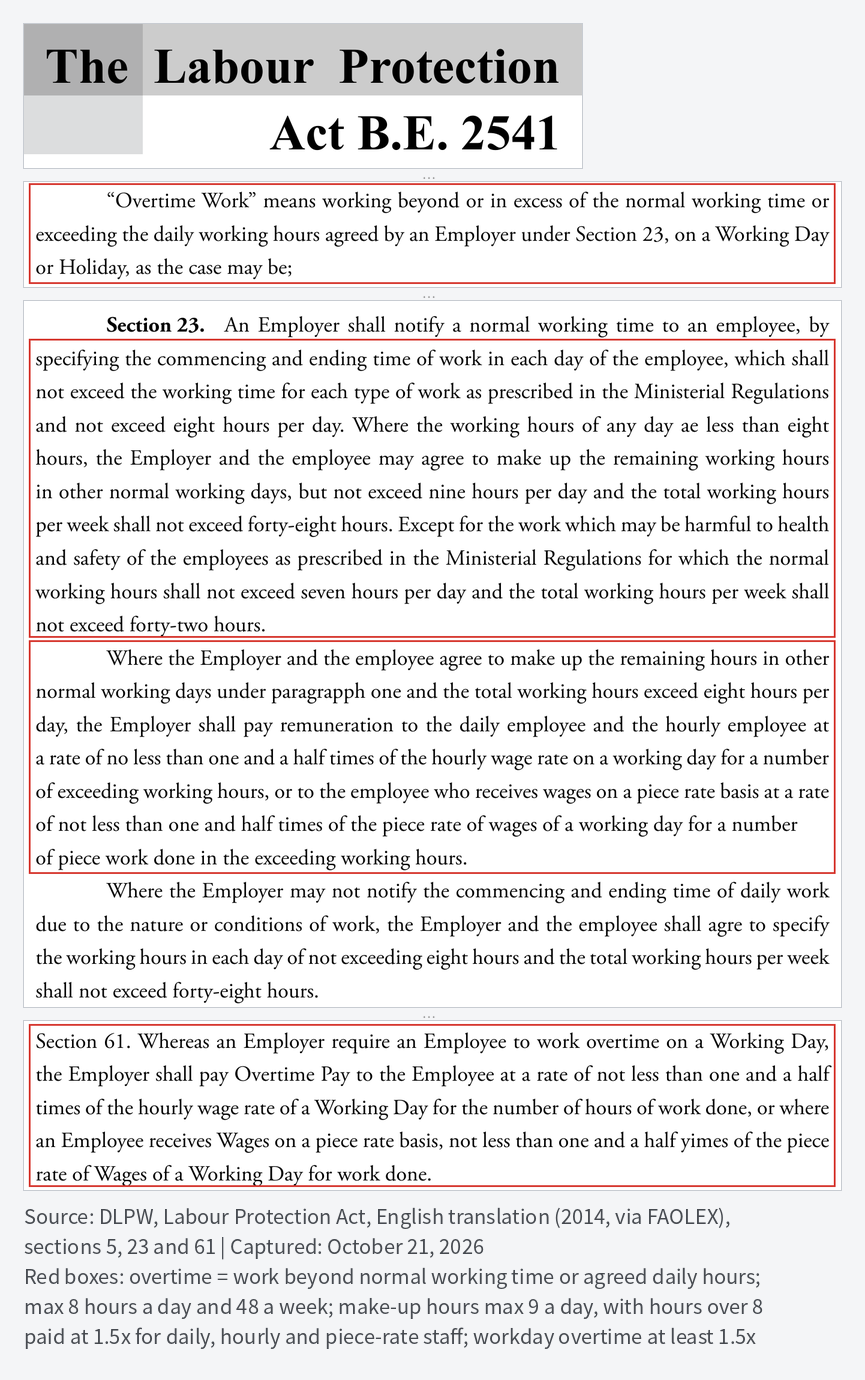
The short answer: Under Section 23 of Thailand's Labour Protection Act, normal working time can't exceed 8 hours a day or 48 hours a week. For work that is hazardous to health and safety, the limits are 7 hours a day and 42 hours a week. Within those limits, the employer sets and notifies the start and finish times. The 48 hours is a cap, not an overtime threshold. Section 5 defines overtime as work beyond normal working time or beyond the agreed daily hours, so overtime is assessed day by day. Where the parties agree in advance to make up short days, employees can work up to 9 hours a day, but daily, hourly and piece-rate employees must still be paid 1.5x for hours over 8. Each instance of overtime requires the employee's prior consent. Overtime and holiday work together are capped at 36 hours a week, and overtime pay can't be replaced with time off in lieu.
Key takeaways
- Cap on normal hours: 8 a day and 48 a week, or 7 and 42 for hazardous work.
- Overtime is daily: anything beyond the company's normal hours for that day counts, even if the weekly total is under 48.
- Make-up hours: short days can be made up on other days under a prior agreement, to a maximum of 9 hours a day.
- 36-hour cap: overtime plus holiday work can't exceed 36 hours a week, and each instance needs prior consent.
- Overtime pay: 1.5x on workdays and 3x on holidays, with no substitution by time off in lieu.
Thailand working hours at a glance (as of October 21, 2026)
- Normal hours and overtime: normal working time is capped at 8 hours a day and 48 a week. Overtime is work beyond normal working time or the agreed daily hours under Section 23. DLPW: Labour Protection Act, English translation, Sections 5 and 23
- Overtime cap: overtime and holiday work together can't exceed 36 hours a week. Same source, Section 26 and the 1998 Ministerial Regulation.
- Time off in lieu: the Act has no provision allowing time off to replace overtime pay, and employees can't waive overtime pay even with their consent. Tilleke & Gibbins: Time Off in Lieu under Thai Labor Law (September 23, 2026)
Sections quoted here are from the DLPW's 2014 English translation; the Thai text prevails. Amendments since 2019 (Nos. 7, 8 and 9) didn't change Sections 5, 23–28 or 61–68, and Amendment No. 8 added Section 23/1.
1. What are Thailand's legal working hours?
Normal working time in Thailand means the daily start and finish times the employer notifies to employees under Section 23 of the Labour Protection Act. It can't exceed 8 hours a day or 48 hours a week. For work that is hazardous to health and safety, the limits are 7 hours a day and 42 hours a week.
The 48-hour figure is a ceiling. In practice, office roles usually work five 8-hour days (40 hours), while factories often work six 8-hour days (48 hours). The normal hours set in your work rules or employment contract are the benchmark for deciding what counts as overtime.
2. Is overtime assessed daily or weekly?
Under Section 5, overtime work means work on a working day or holiday that goes beyond normal working time or beyond the daily hours agreed under Section 23. The benchmark is the company's normal hours for that day, not 48 hours a week.
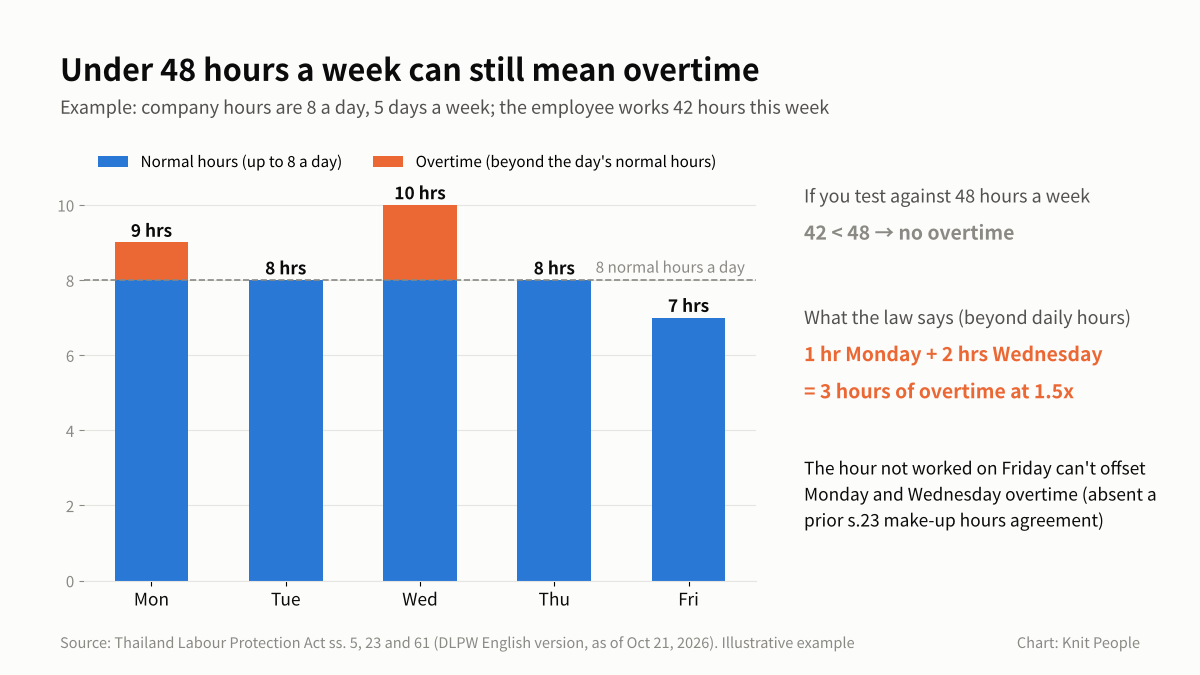
Take the example in Figure 2. The company's normal hours are 8 a day, five days a week. This week, the employee works 9 hours on Monday, 10 on Wednesday and 7 on Friday, for a total of 42 hours, well under 48. But the extra hour on Monday and two hours on Wednesday, three hours in total, are overtime and must be paid at 1.5x. The hour not worked on Friday can't offset them.
3. What flexible working arrangements are allowed?
Points to watch:
- Make-up hours must be agreed in advance. Netting off "short today, long tomorrow" after the fact doesn't comply with Section 23.
- Monthly-paid employees: the 1.5x rule in Section 23, paragraph 2, only mentions daily, hourly and piece-rate employees. How it applies to monthly-paid staff working over 8 hours under a make-up arrangement is unclear. Confirm with Thai counsel, and the safer approach is to pay 1.5x anyway.
- Remote work agreements: Section 23/1 was added by Labour Protection Act Amendment No. 8, in force since April 18, 2023.

4. What are the overtime procedures and limits?
- Consent each time: workday overtime requires the employee's prior consent on each occasion (Section 24). The exception is work that must run continuously, where stopping would cause damage, or emergency work.
- 36-hour cap: workday overtime and holiday work combined can't exceed 36 hours a week (Section 26 and the 1998 Ministerial Regulation). Holiday work includes holiday overtime.
- Holiday work: generally not allowed, except for continuous or emergency work and in sectors such as hotels, transport and food service. It's also allowed for production, sales or service needs if the employee consents in advance each time (Section 25).
- Break before overtime: if overtime after the end of the workday runs over 2 hours, the employee must get at least 20 minutes' rest first (Section 27).
5. How is overtime pay calculated?
Keep in mind:
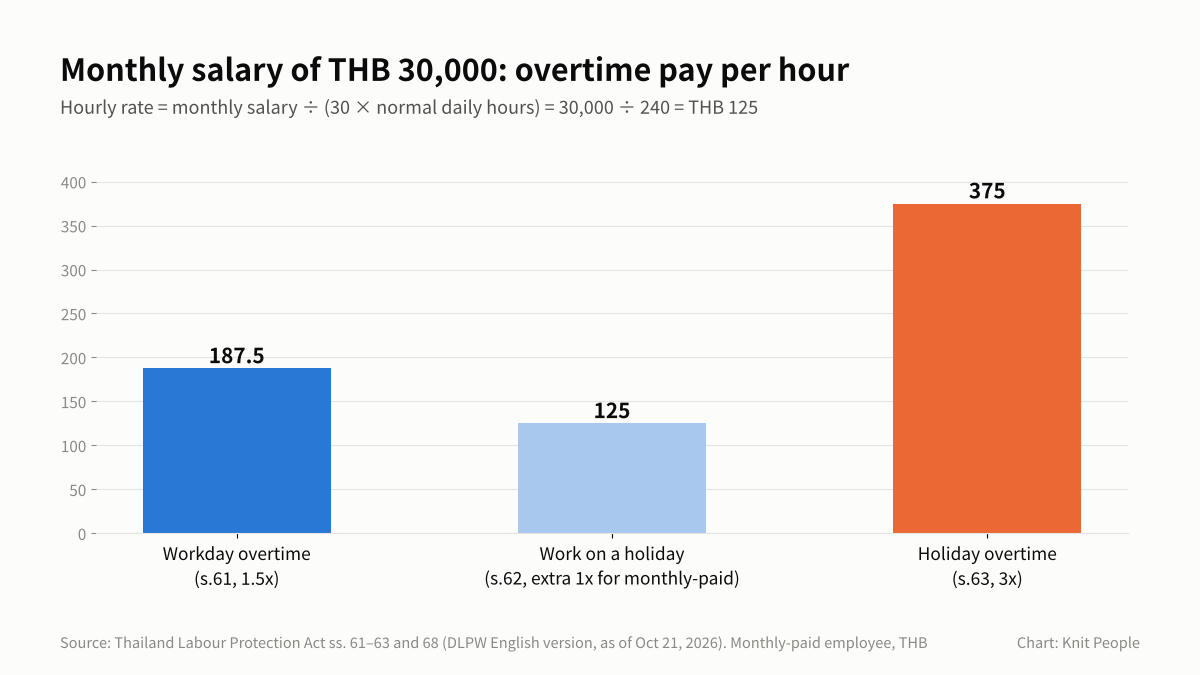
- Hourly rate: for monthly-paid employees, it's monthly wage ÷ (30 × average normal daily hours) (Section 68). That's a divisor of 240 for 8-hour days or 225 for 7.5-hour days.
- What counts as monthly wage: pay that's fixed and paid monthly, which usually includes fixed allowances, not just base salary.
- Exempt employees (Section 65): people with authority to hire and dismiss on the employer's behalf, commission-based outside sales staff, and those whose work is done outside with hours that can't be fixed, among others. Some of these categories still get compensation at 1x the hourly rate. Courts read these exemptions narrowly, so job titles alone aren't enough.
6. What about time off in lieu and late arrivals?
If you want to give employees flexibility over start and finish times, set out a flexible window and the required daily hours in your work rules, rather than netting late arrivals against late departures after the fact.
7. What are the penalties, and what happened to the 40-hour bill?
The 40-hour bill: on September 24, 2025, Thailand's House of Representatives passed a labor rights bill in first reading that would cut the cap on normal hours to 40 a week (35 for hazardous work). The House was then dissolved on December 12, 2025. Under Section 147 of the 2017 Constitution, bills not yet approved by the National Assembly lapse on dissolution unless the new Cabinet asks for them to be revived within 60 days of the new Assembly's first session. We haven't been able to confirm whether this bill has been revived. Either way, the legal cap is still 48 hours a week.
8. The bottom line
Thailand caps normal working time at 8 hours a day and 48 a week, but 48 is a ceiling, not an overtime threshold. Any work beyond the company's normal hours for that day is overtime, must be paid at 1.5x and can't be swapped for time off. To stay compliant:
- Set out daily start and finish times in your work rules, plus any flexible window you want to allow.
- Agree make-up hours and remote work in writing in advance, and stick to the conditions.
- Record attendance daily, get consent for each instance of overtime, and keep overtime plus holiday work within 36 hours a week.
9. About Knit People
Knit People was founded in Canada in 2015 and began as a global payroll provider. It runs four operations centers, in Canada, China, the Philippines and Europe, and holds a government-registered MSB license. Its core services are employer of record (EOR), professional employer organization (PEO), global payroll and contractor of record (COR). It also offers recruitment, entity setup, tax compliance, benefits administration and work visa support. Knit People combines regional operations centers with in-country experts. It covers 172 countries and regions, has served more than 4,000 companies and 12,000 employees, and processes over RMB 4 billion in payroll a year.
10. FAQ
Q1:Is the standard working week in Thailand 48 hours?
48 hours is the maximum, not the standard. Section 23 of the Labour Protection Act caps normal working time at 8 hours a day and 48 hours a week, and employers set their own hours within that limit. Many choose 40 hours a week. For hazardous work, the caps are 7 hours a day and 42 hours a week.
Q2:Is overtime in Thailand calculated daily or weekly?
Daily. Section 5 defines overtime as work beyond normal working time or beyond the agreed daily hours. Even if an employee works fewer than 48 hours in a week, any time beyond the company's normal hours on a given day is overtime.
Q3:Can employers in Thailand offer flexible working hours?
Yes, with conditions. If a day falls short of 8 hours, the parties can agree in advance to make up the time on other workdays, up to 9 hours a day and 48 hours a week. Employers can also set a flexible start window in their work rules. Remote work requires a written agreement under Section 23/1.
Q4:Can time off in lieu replace overtime pay in Thailand?
No. The Labour Protection Act doesn't allow time off to replace overtime pay, and employees can't waive overtime pay even if they agree. Workday overtime is paid at 1.5x and holiday overtime at 3x. Time off can only be given as an extra benefit.
Q5:What is the maximum overtime per week in Thailand?
Workday overtime and holiday work combined can't exceed 36 hours a week. Workday overtime also requires the employee's prior consent each time, except for continuous or emergency work.
11. Sources
- DLPW: The Labour Protection Act B.E. 2541, English translation (2014, via FAOLEX) (accessed October 21, 2026)
- Tilleke & Gibbins: Time Off in Lieu under Thai Labor Law: Opportunities and Limitations for Employers (September 23, 2026) (accessed October 21, 2026)
- Forvis Mazars: Labour Protection Act Amended to Recognize Remote Work and Employee's Right to Refuse Communication (accessed October 21, 2026)
- Tilleke & Gibbins: Two Bills Set to Expand Leave Entitlements and Workers' Rights in Thailand (October 8, 2025) (accessed October 21, 2026)
- Enviliance ASIA: Fate of critical regulations after Thailand's House dissolution (accessed October 27, 2026)
Update log
- October 27, 2026: First published
Disclaimer: This article is based on the English translation of Thailand's Labour Protection Act and public materials from professional firms. It is for general information only and is not legal advice. The Thai text of the law prevails. For specific rostering and overtime arrangements, please consult a qualified Thai lawyer.